VantageScore vs FICO: Loan-Level Evidence From Auto ABS
VantageScore vs FICO stopped being a hypothetical question for securitization investors this spring. On March 4, 2026, the first servicing report for Carvana Auto Receivables Trust 2026-P1 filed something no US auto ABS filing had carried before: two credit scores on the same loan. The obligor credit score field reads VS 801, FICO 736, a VantageScore and a FICO side by side, for the January 2026 collection period. Five months later, 129,768 securitized loans carry both scores, and the count steps up by 40,000 to 50,000 with every new Carvana deal.
The timing matters. The FHFA accepted VantageScore 4.0 for Fannie Mae and Freddie Mac in July 2025 and completed implementation across the agencies in April 2026, so fixed income investors are now pricing collateral disclosed under two competing score models for the first time. Most published VantageScore-to-FICO comparisons come from bureau studies or vendor research. This one comes from SEC filings: the same borrower, both scores, and a monthly performance record attached to each loan in our ABS-EE loan-level data. This post covers when the dual filing started, how fast it is growing, how the two scores map onto each other, and what early delinquency looks like with the same borrowers banded by each score.
The first VantageScores in a Reg AB-II filing
The mechanics are plain once you see a record. Carvana's 2026 deals populate the standard obligorCreditScore item with a text pair instead of a single number:
<obligorCreditScore>VS 801, FICO 736</obligorCreditScore>
<obligorCreditScoreType>Bureau</obligorCreditScoreType>
The type tag still says "Bureau", so nothing in the labeled metadata announces the change. The exhibit's own field definitions do: the 2026-P1 asset file describes blank values as loans "whose obligor (and, if present, co-obligor) did not have a VantageScore or FICO Score, as applicable, at origination." Both scores are origination snapshots, restated verbatim on every monthly report. Loans with a co-obligor flag both scores for the primary obligor only; no co-obligor score is filed.
The FICO member of the pair runs above 850, to 874 in this population, consistent with an auto-industry FICO scale rather than the classic 300-850 range. The VantageScore member peaks in the mid-840s.
This is, as far as I can measure, the only VantageScore disclosure in US auto ABS. I scanned the raw score and score-type fields across all 22 issuer programs in our warehouse, 30.1 million securitized loans and 882 million loan-month records back to 2016, for VantageScore references, "VS"-prefixed values, and any other dual-number format. Every hit is a Carvana 2026 trust. A full-text search of EDGAR for "VantageScore" across ABS-EE filings returns the same three trusts and nothing else.
How fast dual-score disclosure is growing
The dual filing is a new-shelf convention, not a servicer-wide format change. No loan in any pre-2026 Carvana trust ever switched from a plain number to a pair; the split runs exactly along deal lines. Each 2026 deal files pairs on essentially its whole pool from its first report:
| Deal | First collection period | Pool loans | Dual-scored | Coverage |
|---|---|---|---|---|
| 2026-P1 | January 2026 | 39,517 | 39,299 | 99.4% |
| 2026-P2 | April 2026 | 38,690 | 38,480 | 99.5% |
| 2026-P3 | July 2026 | 52,339 | 51,989 | 99.3% |
The disclosure also covers loans added to a trust after closing. 2026-P1 started with 24,167 loans in its January pool and added 15,350 more in February, 39% of the final pool. The added loans are 99.5% dual-scored, every one originated in February 2026 itself, and their credit profile matches the closing pool: median VantageScore 711 against the initial pool's 708, with 19.4% scoring below VS 640 against 20.0%. Origination-to-trust lag is short across the shelf; two-thirds or more of each pool was originated in the month it entered the trust, so the dual-score record starts at month one of each loan's life.
Because each quarterly deal adds its full pool while the older trusts amortize, the dual-scored share of Carvana's reporting book climbs in steps: roughly 7% of reporting loans in January 2026, 14% in April, 21% in July. At the current deal cadence, half of Carvana's reporting loans would carry both scores by late 2027.
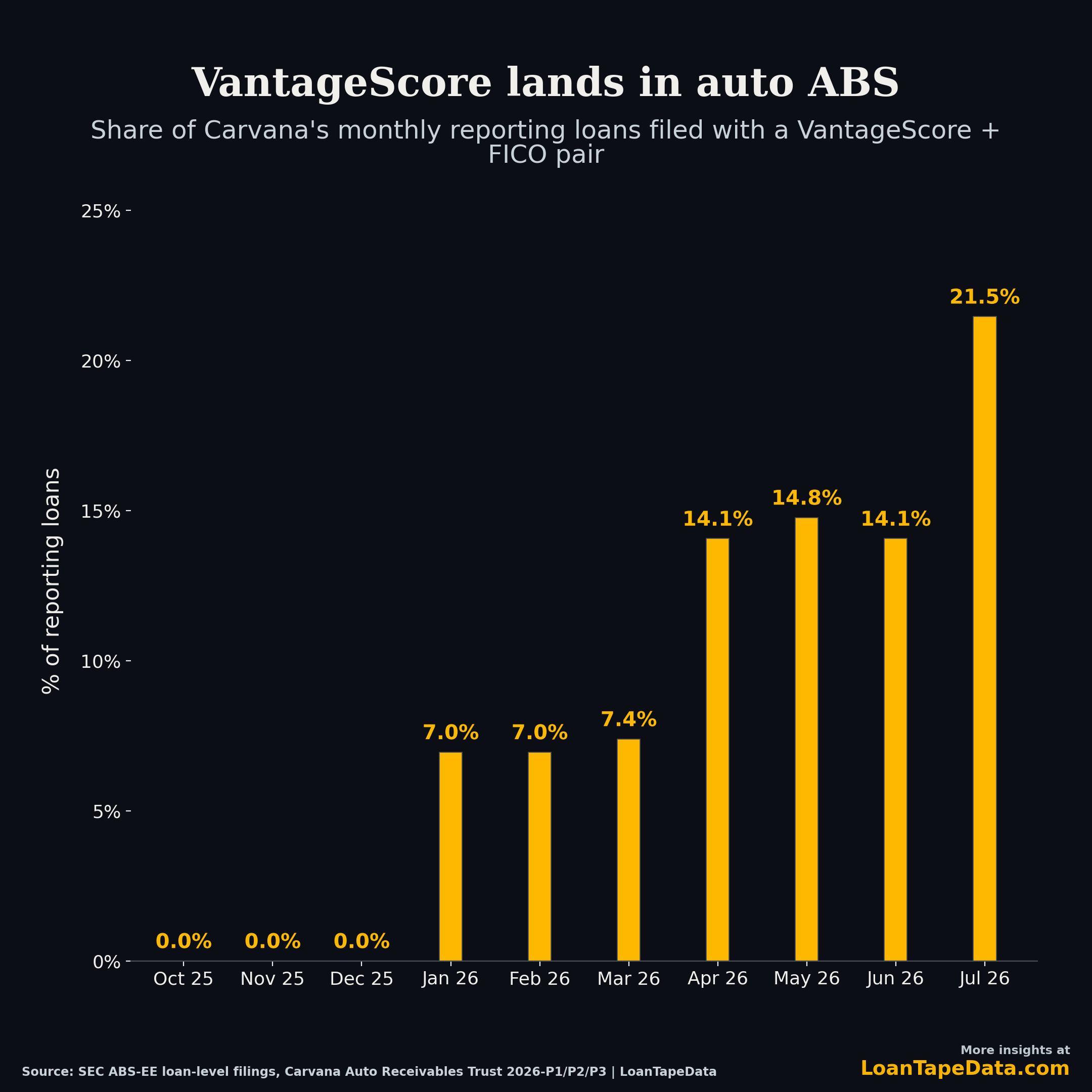
Cut by origination vintage instead of reporting month, the coverage is already near-total: 99.9% of Carvana's securitized 2026 originations are dual-scored (122,941 of 123,012 loans filed so far), along with 5.8% of its 2025 originations that were securitized into the early 2026 deals. Across all issuers, 26% of the 466,937 securitized 2026-vintage auto loans filed to date carry a VantageScore. That market-level figure is inflated by timing, since Carvana files faster than the captives; as other issuers' 2026 paper lands, it settles toward Carvana's typical share of securitized originations, around 5%.
VantageScore vs FICO: the band conversion map
The paired observations are the interesting part. For the 129,768 borrowers carrying both scores, the filings give a direct, loan-level answer to a question that usually requires a bureau study: where does each FICO band land under VantageScore?
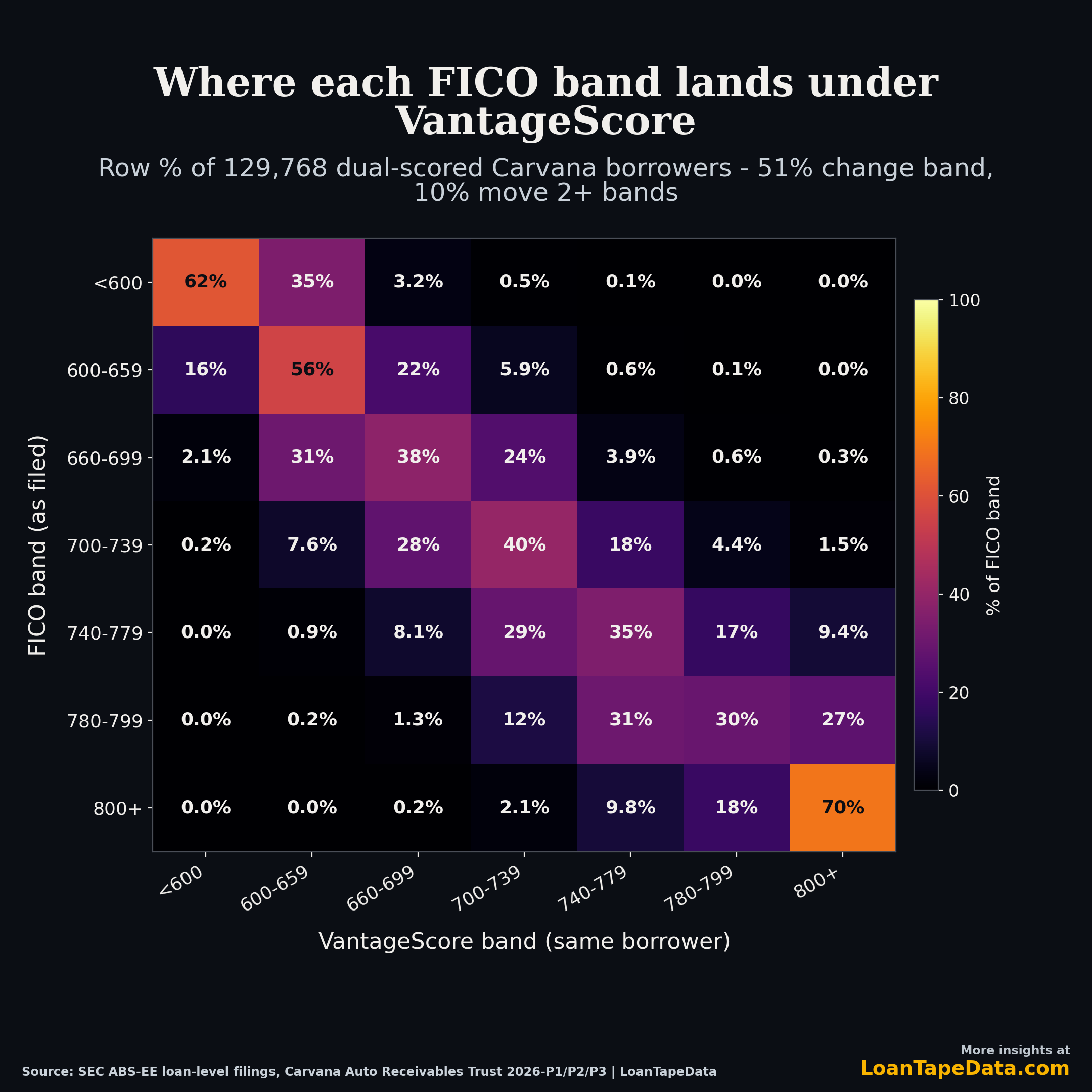
Reading the matrix by row:
- 51.5% of borrowers sit in a different 40-to-60-point band under one score than under the other. 10.5% move two or more bands.
- The tails are sticky. 62% of FICO sub-600 borrowers stay sub-600 under VantageScore, and 70% of FICO 800+ borrowers stay 800+.
- The middle moves. A FICO 660-699 borrower lands 600-659 under VantageScore 31% of the time and 700-739 or better 29% of the time. Only 38% stay in band.
- High-but-not-top FICO scatters most: of FICO 780-799 borrowers, 30% stay in band, 27% land 800+ under VantageScore, and 44% land lower.
Pool-level spreads are small. The median FICO-minus-VantageScore gap is +4 points on 2026 originations and +6 on 2025. Individual gaps are not: the population includes borrowers filed at VS 619, FICO 702 and at VS 612, FICO 555, disagreements of 50 to 90 points in either direction. Each of those disagreements now has a monthly performance record attached to it.
For an investor, the band reassignment matters more than the median. Auto credit decisions bind at band edges, and the movement concentrates in the 600-740 range where pricing tiers usually sit. Score floors are common in securitized auto collateral; I documented a hard 670 floor across every Harley-Davidson motorcycle securitization earlier this year. The same floor drawn against a different score would admit a different set of borrowers, and a pool description that says "weighted average score 720" reads differently depending on which model produced it.
VantageScore vs FICO on early delinquency
With between one and seven monthly reports per loan depending on the deal, the performance record is young; the average dual-scored loan has about 3.5 observed months. That is enough for an early payment signal, not a verdict. I used ever reaching 10 or more days past due (DPD) as the early marker and cut the same 130,000 borrowers twice, once by VantageScore band and once by FICO band:
| Band | Banded by VantageScore | Banded by FICO |
|---|---|---|
| <600 | 6.6% | 6.6% |
| 600-659 | 3.0% | 3.1% |
| 660-699 | 1.6% | 1.6% |
| 700-739 | 1.1% | 0.9% |
| 740-779 | 0.6% | 0.8% |
| 780-799 | 0.5% | 0.4% |
| 800+ | 0.3% | 0.3% |
The gradients are close to identical. At this seasoning, neither score separates early delinquency better than the other on this collateral. The discordant cells, borrowers the two models disagree about by two or more bands, hold about 7,400 loans on one side and 6,200 on the other, and their early delinquency counts are still small enough that I would not read a winner out of them. The version of this table that will matter has 12 or 24 months of seasoning and 30+ DPD and charge-off columns, and it accrues on its own: every new Carvana deal adds another 40,000 to 50,000 dual-scored loans with full monthly histories.
VantageScore vs FICO: quick answers from the filings
Is VantageScore higher or lower than FICO? In this population, slightly lower on average: the median FICO reading sits 4 points above the VantageScore reading on 2026 originations and 6 points above on 2025. The averages hide the spread; individual borrowers differ by 50 to 90+ points in either direction.
How often do the two scores put the same borrower in a different band? 51.5% of dual-scored borrowers change 40-to-60-point band between the two models, and 10.5% move two or more bands. Agreement is highest at the extremes (62% of FICO sub-600 stay sub-600; 70% of FICO 800+ stay 800+) and lowest in the middle bands where auto pricing tiers sit.
Do auto lenders use VantageScore? The filings show disclosure, not underwriting. What the securitized record supports: one issuer, Carvana, files a VantageScore alongside a FICO on its 2026 deals, on ~99.5% of each pool. No other auto ABS issuer disclosed a VantageScore in any form through the July 2026 collection period.
Which score is better at ranking auto credit risk? Too early to say from this collateral. At roughly four months of seasoning, early delinquency gradients are nearly identical banded by either score. We re-run the comparison monthly as the cohorts season.
What to watch
Three things worth tracking from here. First, whether any second issuer follows: today the count of issuers filing a VantageScore in auto ABS is exactly one, and the mortgage side has already moved. Second, the seasoning race. The same-borrower comparison above gets a month of performance with every remittance cycle, and by mid-2027 the 2026-P1 cohort will have 18 months of history, enough for the first real 30+ DPD and charge-off comparison under both scores. Third, band mix. If deal documents or rating criteria ever reference the VantageScore side, the conversion map above is the mechanical translation of every score floor and band cut in the market today.
We refresh this analysis monthly as filings land, alongside the loan-level ABS-EE datasets it is built from. I wrote about Carvana's filing conventions once before, when its 2026-P3 pool resolution needed disambiguation, and the dual-score population sits in the same deals. Loan-level extracts with both scores split into columns, joined to the monthly performance panel, are available to subscribers.
Data note
Population: Carvana Auto Receivables Trust 2026-P1, 2026-P2, and 2026-P3, ABS-EE asset-level exhibits, collection periods January through July 2026, plus the full 22-issuer auto loan warehouse for the exclusivity scan and market denominators. Scores are parsed from the as-filed obligorCreditScore text; a pair is any value matching the VS <n>, FICO <n> pattern. Bands are 40-to-60-point cuts at 600/660/700/740/780/800, applied identically to both scores. Deal and pair counts are exact distinct-loan counts on deduplicated filing records; a loan's trust-add month is its first-seen reporting month, and the monthly panel shares are approximate distinct counts. Delinquency uses the filed days-past-due status on deduplicated loan-month records. The FHFA dates are from the agency's July 8, 2025 announcement and the April 2026 joint FHFA-HUD implementation release. Every other figure in this post traces to the filings; nothing is modeled.