1.99M auto loans that never left their trusts
1,994,611 loans with no exit
Across every auto ABS issuer in the LoanTape pipeline, 1,994,611 loans appeared in a trust's ABS-EE loan tape in one reporting period and were absent from the next, with no payoff, no charge-off, no repurchase and no liquidation recorded in between. A loan with a positive balance that stops being reported is a gap in the record, and this was a large one. I traced every one of those loans to a cause. 1,990,399 of them, 99.8%, never left their trust at all. The remaining 4,212 did stop being reported, and the record now says so explicitly instead of guessing.
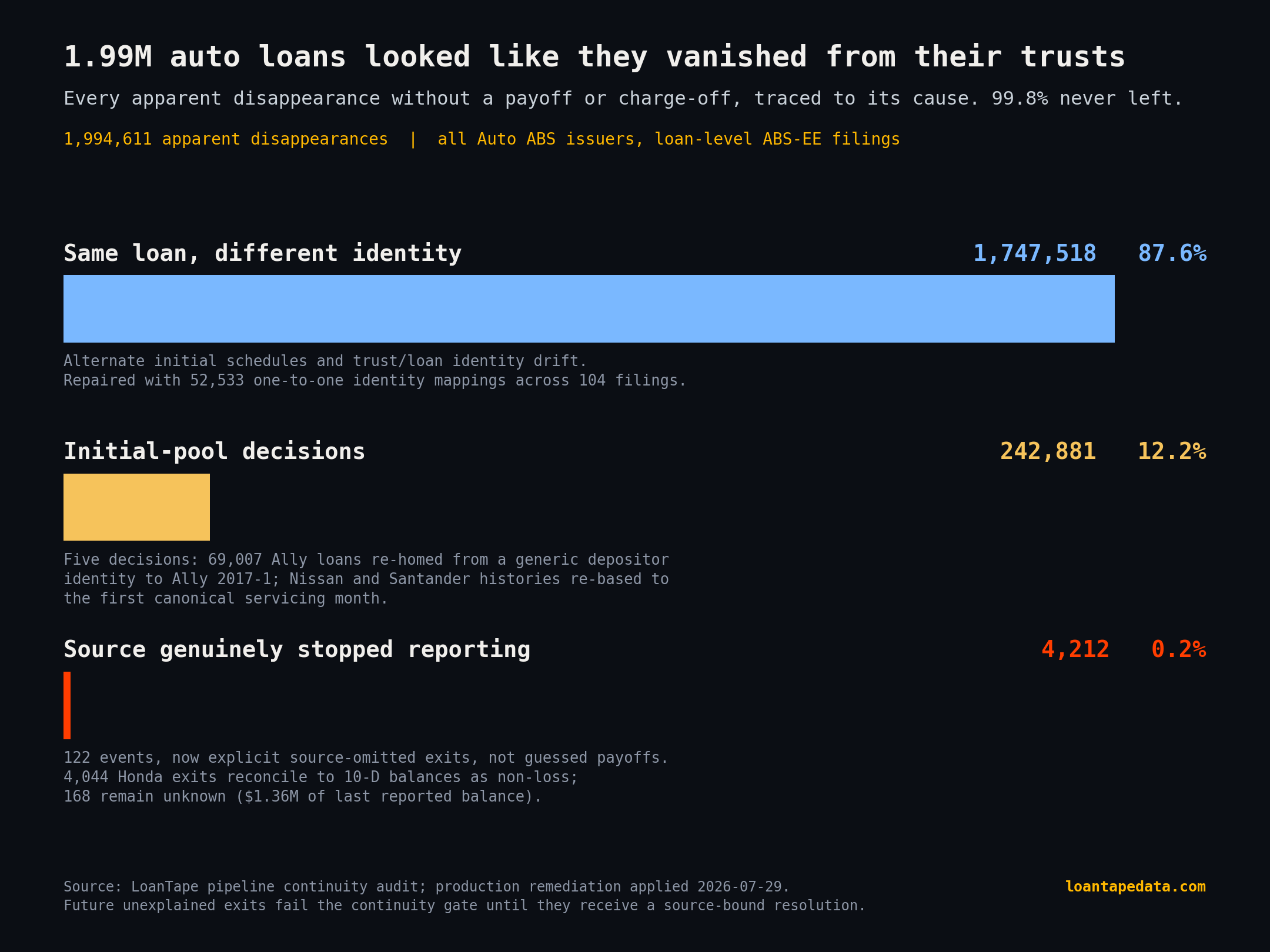
The chart shows the whole result: three bars, one per cause. The first bar, 1,747,518 loans, is the same loan reappearing under a different identity. The second, 242,881 loans, is five decisions about which filing marks the start of a trust's history. The third bar is barely visible at this scale: 4,212 loans, 0.2%, where the issuer genuinely stopped reporting a positive-balance loan. That third bar is the only one with any economic content, and even most of it reconciles to the trust's Form 10-D as a non-loss event.
Why an unreported loan changes the metrics
A loan that stops appearing in the tape has to be treated as something. There is no neutral option. Every cohort metric a structured-finance reader cares about is a fraction, and the missing loan either lands in the numerator, or it leaves the denominator, or it does both.
Treat it as a prepayment and prepayment speeds rise. The loan looks like a voluntary payoff at whatever balance it last reported, so the trust appears to pay down faster than it does, and any conditional prepayment figure built on that trust inherits the error.
Treat it as an unexplained survivor loss and the denominators shrink. Cumulative net loss is loss divided by original balance, so that ratio holds still, but any metric with a current-balance denominator does not. Thirty-plus days past due (DPD) as a share of active balance is the obvious one. If the loans that stop being reported are disproportionately current, the surviving population is disproportionately delinquent and the delinquency line rises in its final months for no reason connected to borrower behavior. A vintage that appears to deteriorate late in its life may simply be a vintage whose current loans stopped being counted.
Treat it as nothing, keep the loan in the population at its last balance, and every monthly roll rate carries a set of loans that never transitions anywhere.
None of these is acceptable at 1,994,611 loans, which is why the pipeline's continuity gate exists. The gate's rule is simple to state: an active loan cannot disappear between adjacent reporting periods unless a source-supported terminal event exists. Before this remediation, that rule was failing on a population large enough to move every published cohort curve.
How ABS-EE filings create the problem
Nothing in an ABS-EE filing says "this loan is the same loan as that one." Each monthly exhibit is a flat schedule of asset records with an identifier, a set of balances and a set of status fields. Continuity between months is something the reader has to establish, and the filings make that harder in four distinct ways.
Issuers file alternate initial schedules. A new trust often files more than one complete loan tape before its first servicing period: a statistical pool, a pricing pool, a base and an upsize alternative. Only one becomes the trust. I wrote about a live example last month, when Carvana 2026-P3 filed two complete tapes six minutes apart, and the pipeline quarantined both until a servicing tape could settle the question. Every loan in a schedule that was not selected looks, to a naive continuity check, like an active loan that vanished between the initial filing and the first monthly one.
Trust identities drift. The same trust can appear under a generic depositor identity in one filing and under its own name in the next. To the pipeline, those are two trusts: one whose entire population disappears and one whose entire population appears with no prior history.
Loan identifiers drift. Between an initial schedule and the first monthly servicing tape, an issuer may change the asset identifier scheme entirely. The loans are the same; the keys are not. Exact-key matching finds zero overlap, and the entire pool registers as a disappearance and a fresh addition on the same day.
Sponsors re-file. A corrected or superseding filing can carry a different population from the one it replaces. Without a decision about which filing is canonical, both contribute rows and the difference between them shows up as loans leaving.
Each of these is a filing-structure artifact rather than a credit event. The work was to prove that, loan by loan, and to write rules that keep proving it on every future filing.
The three-way decomposition
| Cause | Loans | Share | What was done |
|---|---|---|---|
| Alternate initial schedules and trust/loan identity drift | 1,747,518 | 87.6% | 104 filing decisions; 52,533 one-to-one identity mappings |
| Initial-period pool decisions | 242,881 | 12.2% | Five decisions: 69,007 Ally loans moved to Ally Auto Receivables Trust 2017-1; two Nissan and two Santander histories re-based |
| Source genuinely stopped reporting | 4,212 | 0.2% | 122 events recorded as explicit source-omitted exits; 4,044 reconciled to 10-D as non-loss, 168 unknown |
| Total | 1,994,611 | 100% |
Same loan, different identity: 1,747,518
The largest bucket resolved through two kinds of decision. The first was a filing decision: for each trust and reporting period, which schedule is the performance pool? Alternate initial schedules were removed from trusted membership, never combined with the servicing population, and never deleted from raw lineage. There were 104 of these decisions.
The second was an identity mapping: where a trust or loan changed identifier between filings, the old key was mapped to the new one. The rule for these is strict. Every mapping is one-to-one. A source key that could match two targets, or two source keys that could match one target, is not mapped; it is quarantined. Fuzzy matches are not permitted. 52,533 mappings met that standard and were applied. Between the filing decisions and the mappings, 1,747,518 apparent exits became continuous histories.
Initial-period pool decisions: 242,881
Five decisions, each about where a trust's history begins, accounted for the rest of the false disappearances.
69,007 Ally loans were carried under a generic depositor identity rather than under Ally Auto Receivables Trust 2017-1. Moved to the trust they belong to, they stop looking like a population that appeared and then disappeared. The production postcondition is exact: zero Ally rows under the generic trust for the corrected period, and exactly 69,007 under the authoritative one.
Two Nissan histories and two Santander histories now begin at the first canonical servicing population rather than at a pre-servicing schedule. The raw pre-servicing schedules stay in the Bronze and staging layers; they are simply not the start of the performance record.
Source genuinely stopped reporting: 4,212
This is the bucket with economic content. Across 122 later-period events, 4,212 loans with positive balances were present in one monthly tape and absent from the next, with no terminal field set and no offsetting change that could explain them. I did not infer them as payoffs, and I did not infer them as losses. Each is now an explicit source_omitted_exit record with a classification.
4,044 of them are Honda exits. For those I had an independent check: the trust's own 10-D distribution report states the pool balance and the period's charge-offs. The Honda omissions reconcile to the 10-D pool balances and charge-offs, which is the basis for the classification non_loss. The loan-level tape stopped carrying them, but the trust-level report accounts for them without a loss.
The other 168 remain unknown. Their last reported balance totals $1,355,644.66. I cannot say from the filings what happened to them, and the release metadata carries that uncertainty rather than resolving it by assumption.
What was applied to production
The remediation was applied to production on 2026-07-29. Two rollback journals record the change. Bronze, the raw filing layer, was not modified; no raw reingestion and no Silver-static rebuild was run. The applied state was checked against a short list of exact postconditions: zero filing-pool quarantine rows, zero rows in the four excluded pre-servicing Silver slices, zero Ally rows under the generic trust for the corrected period, exactly 69,007 Ally loans under Ally Auto Receivables Trust 2017-1, and exactly 4,212 unique source-omitted exits split 4,044 non_loss and 168 unknown.
No trust-wide quarantine remains. The rule going forward is the one the gate was always meant to enforce: an unexplained exit fails the continuity gate unless it receives a new source-bound resolution.
The first filing to test the new rule
The next daily filing after the remediation tested it. Fifth Third Auto Trust 2023-1's June 2026 tape contained 37,084 loans, of which 37,073 were present in May. The automatic pool rule as first written, v1, compared the June population only with the immediately prior one, saw 11 keys that were not in May, and quarantined the whole filing.
I checked the 11. Every one was present in the trust's initial July 2023 population. Ten were last reported at zero balance in March or April 2026 and one in May 2025. Every June reentry carried zero beginning balance, zero ending balance, and zero payment, principal, charge-off, recovery, repurchase or liquidation activity. None matched any of the 1,242 legitimate May exits under an exact source ID, a normalized source ID or a strict economic fingerprint, so no identity crosswalk was created for them. May's ending balance and June's beginning balance were both $378,324,430.05, with zero active-loan disappearances.
These were previously reported loans that the June tape listed again at zero balance, not new collateral and not identity breaks. Rule v2 accepts exactly this case and nothing wider: a same-key, economically inert reentry that was present in the trust's initial population and whose last prior observation ended at zero balance. It continues to reject new collateral, any reentry with an active balance, and any addition that would net against a disappearance. In the production shadow preview, across four pending filing candidates, exactly this one decision moved from quarantine to include. The other three stayed quarantined and no other decision changed.
The certification that followed audited 18,098 adjacent-period pairs, certified 18,074 and excluded 24 quarantined pairs. Every blocking count was zero: active disappearances, active disappeared balance, onboarding balance, included quarantine, failed pairs, duplicate pairs and unclassified exits.
What this means for the numbers you see
Every cohort curve on the Auto ABS dashboard now runs on a population where a loan leaves its trust only when a filing says why. Prepayment, cumulative loss and delinquency denominators are built from the same continuous histories, and the 4,212 loans that did leave without explanation are labeled as such rather than folded into a payoff or a loss.
The number I would watch is the 168. They are the only loans in 1,994,611 whose outcome the filings do not settle, and they total $1,355,644.66 of last reported balance. If a later 10-D or a corrected tape resolves them, the classification changes; until then, unknown is the accurate label.
Data note
Every figure in this post comes from the production remediation evidence recorded on 2026-07-29 and the Fifth Third follow-up recorded on 2026-07-30. The 1,994,611 total is the sum of the three resolved components (1,747,518 + 242,881 + 4,212), and the 99.8% is the share of that total explained by the first two. The Honda non_loss classification rests on reconciliation to the trusts' SEC 10-D pool balances and charge-offs, not on the loan tape alone. Raw filings were not altered at any step; every decision is a membership or identity decision layered on top of unchanged Bronze lineage. The loan-level data behind every published trust, gated by the continuity rules described here, is available on every plan.