In SBA's March 2026 loan file, 20.6% of active 7(a) franchise startup loans approved in FY2018-23 were delinquent, past due, deferred, in liquidation or already purchased by SBA. For loans that financed the purchase of an existing franchise unit, the share was 10.7%, the lowest of any group I measured.
The same comparison for independent businesses is much closer: 15.2% for startups and 12.6% for acquisitions.
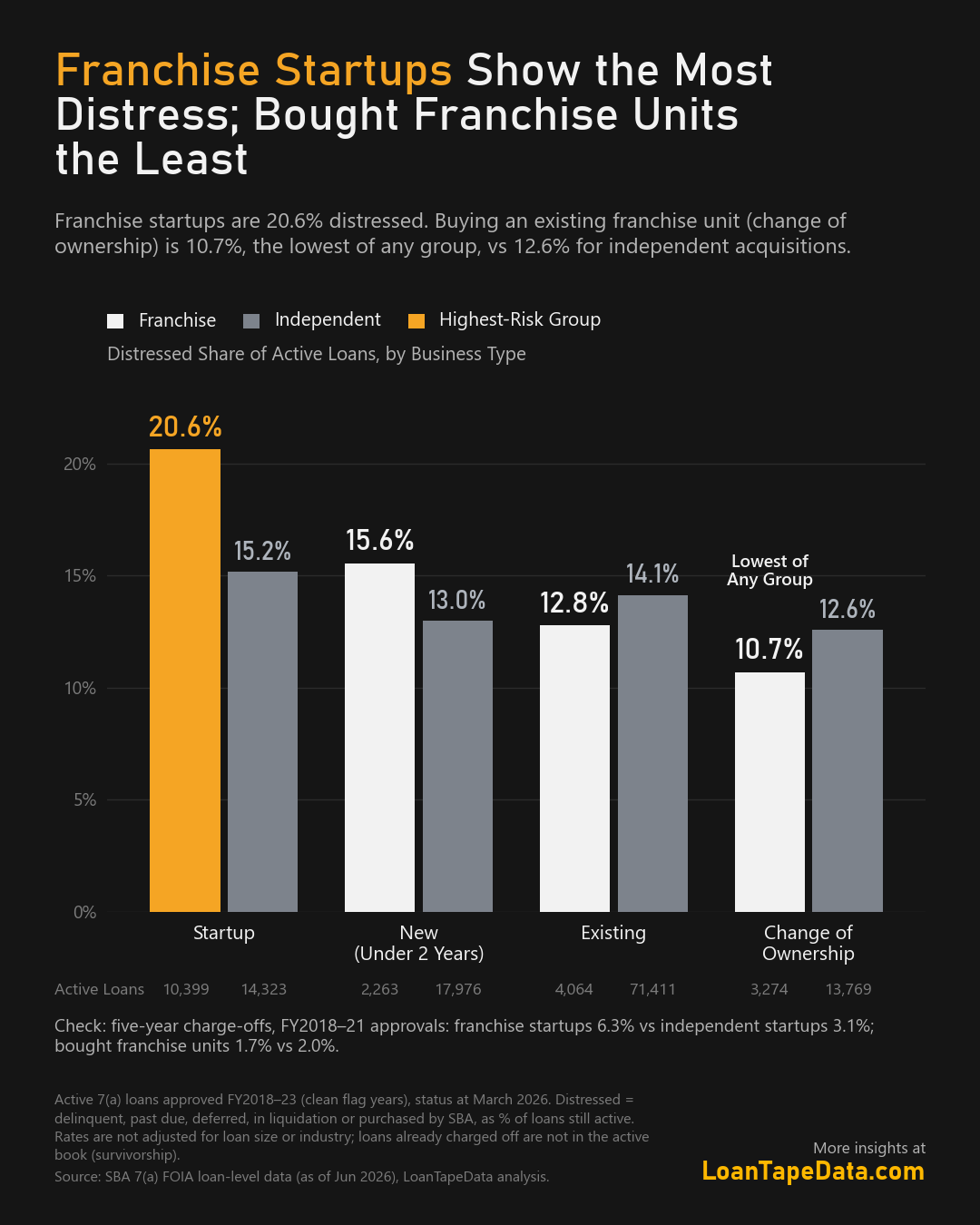
The numbers by business type
SBA records a business-age field on each 7(a) loan. Since FY2018 it separates startups, new businesses under two years old, existing businesses and changes of ownership. I limited this cut to FY2018-23 approvals because the franchise flag is incomplete for FY2024-25, which I covered in an earlier post.
| Business type | Franchise distressed | Independent distressed | Franchise loans | Independent loans |
|---|---|---|---|---|
| Startup | 20.6% | 15.2% | 10,399 | 14,323 |
| New (under 2 years) | 15.6% | 13.0% | 2,263 | 17,976 |
| Existing business | 12.8% | 14.1% | 4,064 | 71,411 |
| Change of ownership | 10.7% | 12.6% | 3,274 | 13,769 |
Distressed means the loan was delinquent, past due, deferred, in liquidation or purchased by SBA in the March 2026 release, as a share of loans still active. That release is the only recent one with that status detail.
Two things stand out:
- Franchise startups show more distress than independent startups, by 5.4 percentage points.
- For existing businesses and acquisitions, franchise loans show less distress than independents.
Checking it against charge-offs
An active-book snapshot leaves out loans that have already been charged off. If franchise startups charged off early and left the book, the snapshot would understate their problems. If independents did, it would flatter franchise.
Five-year charge-off rates for FY2018-21 approvals point the same way as the snapshot:
| Business type | Franchise 5-year charge-off | Independent 5-year charge-off |
|---|---|---|
| Startup | 6.3% | 3.1% |
| Change of ownership | 1.7% | 2.0% |
Franchise startups charged off at about twice the rate of independent startups. Franchise acquisitions charged off slightly less often than independent acquisitions.
These rates are not adjusted for loan size or industry. Franchise startup loans are more concentrated in restaurants (25% vs 20% of independent startups) and fitness (14% vs 5%), and the brand-maturity post shows how much new brands drive the franchise numbers.
How it fits the earlier work
In April I looked at SBA charge-off rates for acquisitions versus startups across all 7(a) borrowers. Buying an operating business showed lower charge-offs than starting one. The franchise split sharpens that: the gap between starting and buying is wider for franchise loans than for independents.
A loan that buys an existing franchise unit comes with an operating history, a location that has already opened and a brand that has at least one working unit. A franchise startup loan has none of those.
Where this leaves the franchise question
Taken alone, "franchise" is a weak risk variable in SBA 7(a) data. Split by business type, it separates clearly:
- Franchise startups: the most distress of any group in this cut.
- Franchise acquisitions: the least distress of any group in this cut.
The loan-level business-age, franchise and status fields used here are in the SBA 7(a) dataset.
The deep dive
This post is part of a new 19-page deep dive on SBA franchise risk, which also covers brand track record, 22 well-known brands and the lenders behind the excess charge-offs. Preview the SBA franchise deep dive, or see the SBA plans.
Methodology
Source: SBA 7(a) FOIA loan-level data. Snapshot: March 31, 2026 release, active 7(a) loans approved FY2018-23. Business type is SBA's business-age field. Distressed statuses are DELINQ, PSTDUE, DEFERD, LIQUID and PURCH(NOT C/O); the denominator also includes CURR and SOLDNC. Five-year charge-offs use the June 30, 2026 release and count charge-offs within five years of approval, FY2018-21.